
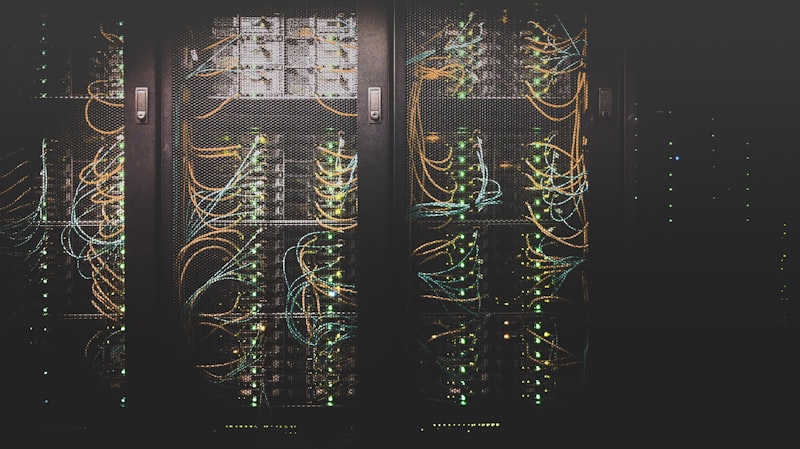
Active equipment is replaced every few years. Cabling stays in the walls for fifteen or more, and replacing it means disruption to a building already in use. It deserves more attention than it usually gets.
Why "structured" matters
A structured system follows a defined topology — work area outlets, horizontal cabling to a floor distributor, backbone between distributors — under standards such as ISO/IEC 11801 and TIA-568. The practical benefit is that any outlet can serve any service: a desk today, a camera or access point tomorrow, with a patch lead rather than a new cable pull.
Choosing the copper category
- Cat5e — supports 1 Gigabit. Adequate only for replacing a few faulty links in an existing estate; not a sensible choice for new work.
- Cat6 — the common baseline. 1 Gigabit comfortably; 10 Gigabit only over short distances, so treat it as a Gigabit system.
- Cat6A — 10 Gigabit across the full 100 m channel. Better heat behaviour in bundles and better shielding, which increasingly matters as PoE power rises. This is what we normally recommend for new commercial installations.
Note the 100 m limit is the total channel: roughly 90 m of fixed cable plus patch leads at both ends. Anything beyond that needs fibre or an intermediate distributor.
Power over Ethernet changes the calculation
PoE now powers cameras, access points, phones, door controllers and displays. Higher-power standards (PoE++ / 802.3bt, up to about 90 W) push real current down the cable, which produces heat in large bundles and can degrade performance. This is a design consideration: use higher-quality cable with better thermal characteristics, keep bundle sizes sensible, and derate where cables run in insulated or hot voids. In our climate this is not a theoretical concern.
Fibre for backbone and distance
- OM4 multimode — cost-effective for in-building backbones, supporting 10G over several hundred metres.
- OS2 single-mode — for campus links and anything that may need to grow. The fibre is inexpensive; the labour of installing it twice is not. On any site with buildings more than a short distance apart, single-mode is usually the economical long-term choice.
Fibre also gives electrical isolation between buildings, which removes a real source of equipment damage where earthing differs or lightning is a risk.
Test it, and get the results
This is the step most often skipped, and it is what separates a professional installation from a working-for-now one. Every link should be certified with a calibrated tester against the standard for its category — not merely shown to pass traffic. A wire-map continuity check is not certification.
Insist on the test result file for every outlet at handover. It is your evidence the installation met specification, and your baseline when something misbehaves in three years.
Documentation and labelling
Undocumented cabling costs money every time anything changes. At minimum, require consistent labelling at both ends of every link, a port-to-outlet schedule, rack elevation drawings, and as-built floor plans with containment routes. Tidy patching in the rack is not cosmetic — it determines whether a fault takes ten minutes or an afternoon.
Common and expensive mistakes
- Exceeding bend radius, or over-tightening cable ties — both change cable geometry and cause intermittent faults that are miserable to trace.
- Running data cable alongside mains power without separation, inviting interference.
- Under-providing outlets to save a little now, then surface-trunking later at greater cost and worse appearance.
- Sizing racks and containment with no spare capacity for growth.
TSB Smart Tech designs and installs structured cabling and fibre backbones — including excavation and external routes — with full certification testing and documentation. Get in touch to discuss your site.