
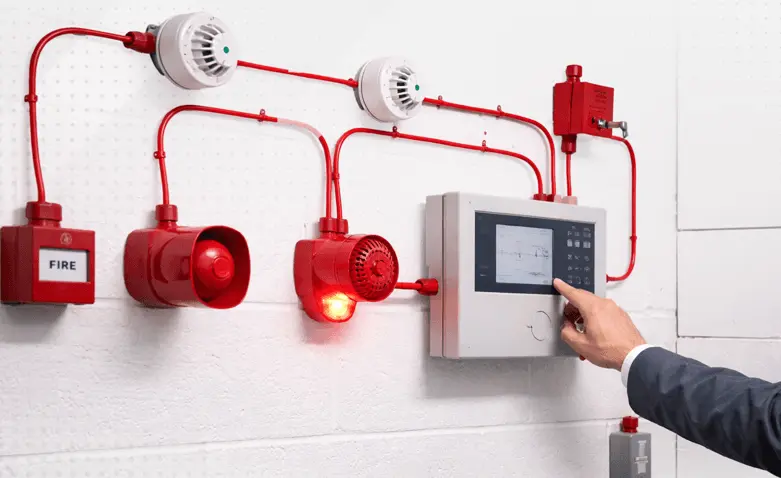
What Is a Fire Alarm System?
A fire alarm system is a network of devices designed to detect signs of fire—such as smoke or excessive heat—and alert people inside a building.
A typical system may include:
Smoke detectors
Heat detectors
Manual call points
Fire alarm control panels
Audible sounders and visual indicators
Input/output modules
Alarm notification devices
Backup batteries
Monitoring and communication equipment
These components work together to detect potential fire conditions and quickly communicate an alarm throughout the building.
How Does a Fire Alarm System Work?
The process begins when a detector identifies a possible indication of fire.
For example, a smoke detector may detect smoke particles in the air. The detector sends a signal to the fire alarm control panel, which processes the information and determines the appropriate response.
If an alarm condition is confirmed, the system can activate:
Audible alarms and sounders
Visual alarm indicators
Building evacuation notifications
Connected fire protection systems
Monitoring or communication systems
Other programmed emergency functions
This rapid response is critical because early detection can significantly reduce the time between the beginning of a fire and evacuation or emergency intervention.
Main Components of a Fire Alarm System
1. Smoke Detectors
Smoke detectors are designed to identify smoke particles produced by a developing fire. They are commonly installed in offices, corridors, commercial buildings, hotels, and other occupied areas.
Different environments may require different detector technologies depending on the building's design and potential sources of false alarms.
2. Heat Detectors
Heat detectors respond to a significant increase in temperature or a predefined temperature threshold.
They can be particularly useful in locations where smoke detectors may not be suitable because of dust, steam, fumes, or other environmental conditions.
3. Manual Call Points
Manual call points allow a person who discovers a fire to manually activate the fire alarm.
They are typically positioned along evacuation routes and near exits so that occupants can raise the alarm quickly.
4. Fire Alarm Control Panel
The control panel is the central component of the system. It receives signals from detection devices, processes alarm or fault conditions, and controls notification devices and other connected equipment.
A modern control panel can also help facility managers identify the location or zone associated with an alarm or system fault.
5. Sounders and Visual Indicators
When an alarm occurs, sounders provide an audible warning to occupants. Visual alarm indicators can provide an additional warning, which is particularly important in noisy environments or for people who may not hear an audible alarm.
Addressable vs. Conventional Fire Alarm Systems
Two common fire alarm system architectures are conventional and addressable systems.
Conventional Fire Alarm Systems
A conventional system divides a building into zones. When an alarm occurs, the control panel identifies the affected zone rather than the exact individual detector.
These systems can be a practical solution for certain smaller or simpler buildings.
Addressable Fire Alarm Systems
An addressable system gives individual field devices unique addresses. This allows the control panel to identify the specific detector, manual call point, or other device that has generated an alarm or fault.
Addressable systems can provide greater information and flexibility, making them particularly useful for larger or more complex facilities.
Choosing the Right Fire Alarm System
There is no single fire alarm solution that is ideal for every building. System design should consider factors such as:
Building size and layout
Occupancy type
Number of floors
Environmental conditions
Fire risks
Evacuation routes
Required detection coverage
Integration with other safety systems
Applicable regulations and standards
A professional fire alarm company can assess these factors and develop a system appropriate for the specific facility.
Why Regular Fire Alarm Maintenance Matters
Installing a fire alarm system is only the beginning of fire safety.
Over time, detectors can become contaminated with dust, batteries can lose capacity, wiring can develop faults, and devices may become damaged or incorrectly configured.
Regular inspection and maintenance can help ensure that:
Detectors remain operational
Batteries and power supplies are checked
Alarm devices function correctly
Faults are identified early
Manual call points operate properly
Control panels remain in normal operating condition
The system continues to perform as designed
A maintenance program should follow the applicable local requirements and relevant fire safety standards.
Choosing the Right Fire Alarm System
There is no single fire alarm solution that is ideal for every building. System design should consider factors such as:
Building size and layout
Occupancy type
Number of floors
Environmental conditions
Fire risks
Evacuation routes
Required detection coverage
Integration with other safety systems
Applicable regulations and standards
A professional fire alarm company can assess these factors and develop a system appropriate for the specific facility.
Fire Alarm Systems Are an Investment in Safety
A fire alarm system is more than a collection of detectors and alarms. It is an integrated safety solution designed to provide early warning, support evacuation, reduce potential damage, and protect people and property.
Whether you are constructing a new facility, upgrading an existing system, or planning a maintenance program, choosing the right fire detection and alarm solution is an important step toward creating a safer building.
Conclusion
Fire emergencies can happen unexpectedly, but buildings can be prepared to respond.
A properly designed, installed, tested, and maintained fire alarm system provides an essential layer of protection by detecting potential fire conditions and warning occupants as early as possible.
For commercial, industrial, residential, and institutional facilities, professional fire alarm design and maintenance can make a significant difference when every second matters.
Common questions from buyers evaluating Fire Alarm System for their facility.
Q: Is a Conventional or Addressable system right for my property?
A: Conventional is cheaper and best for small, simple spaces. Addressable is better for multi-story or large buildings because it shows the exact location of a fire.
Q: What drives the total cost of installation?
A: Beyond the control panel and sensors, a significant portion of the budget goes toward fire-rated cabling, labor, programming, and official safety certification.
Q: How do I make sure the equipment will pass civil defense inspections?
A: Yes. You must budget for mandatory semi-annual maintenance inspections, periodic sensor replacements, and optional 24/7 central monitoring subscriptions.
Q: Can I see the system before buying?
A: Demo / reference site policy.